




Blog
With Kubernetes Uncontained, Flox Unlocks Faster, More Reproducible Deployments on K8s
Steve Swoyer | 10 November 2025

Kubernetes delivers a rock-solid, highly available foundation for running and scaling workloads.
Its superpower is extensibility. From the start, Kubernetes was built like an operating system for cloud-native workloads: It defines a “kernel” (the control plane), elegant, well-defined APIs, and background services—controllers and operators—that reconcile cluster state. Driver-style plug-ins (CRI for runtime, CNI for networking, CSI for storage) plus CRDs and operators let teams extend and swap components without modifying this core.
With Kubernetes, Uncontained, Flox builds on that extensibility to run imageless container workloads. Instead of pulling digest-pinned images, you simply reference declarative Flox environments in your Pod templates. On start, a Flox-maintained containerd shim pulls the versioned environment from FloxHub and realizes dependencies into an immutable, hash-addressed node-local store.
This gives you fast, predictable deployments. Other benefits include:
-
No registry push/pull cycles for updates. CI updates a reference in a Pod template instead of rebuilding and pushing images.
-
No more runtime image pulls/unpacks. The shim activates the environment and mounts hash-addressed paths from a read-only, node-local cache.
-
One environment, everywhere. The same declarative env runs in dev → CI → prod. On x86 and ARM.
-
SBOMs by default. Packages get persisted as SHA-256-hashed store paths to an immutable, node-local store. Dependencies defined in Flox environments map precisely to these store paths. This gives you tamper-evident provenance by construction. Even better, it means the set of store paths is the SBOM.
-
Simplified CI pipelines, same CI patterns. Keep your CI as-is; cut down on image rebuilds and registry round-trips. Bonus: You get provenance by construction and atomic roll backs with one-line changes.
The following article briefly walks through how Kubernetes, Uncontained plugs into Kubernetes itself—without changing its API. For a longer, in-depth overview, refer to this article, or read the docs here.
Kubernetes, Uncontained
Like Kata Containers and gVisor, Kubernetes, Uncontained uses CRI hooks to control pod startup behavior.
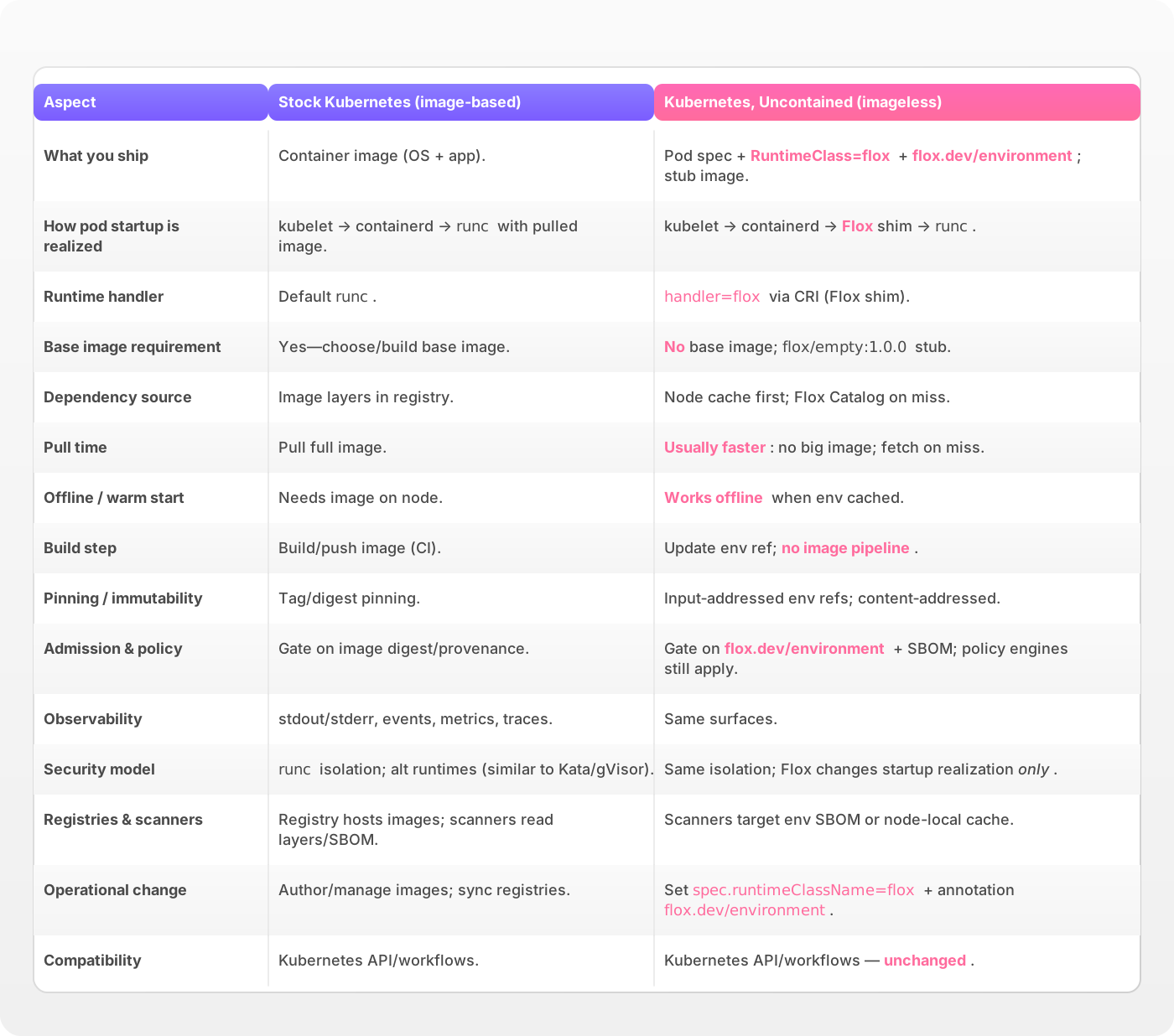
Notwithstanding its name, Kubernetes, Uncontained still runs standard containers inside of pods. At startup, Flox’s runtime shim loads a 49-byte flox/empty:1.0.0 stub image. In this sense Kubernetes, Uncontained is an imageless container pattern: flox/empty:1.0.0 is an “image” only in a pedantic sense; it exists solely to comply with the CRI/OCI standard, while the container’s root filesystem is realized from the input-addressed Flox environment that the shim activates.
This works because of the CRI: the locus of control at the kubelet→containerd boundary. When you define a RuntimeClass with handler: flox and set spec.runtimeClassName: flox, kubelet passes that handler to the runtime daemon (e.g., containerd) via CRI, which routes pod startup to the Flox shim.
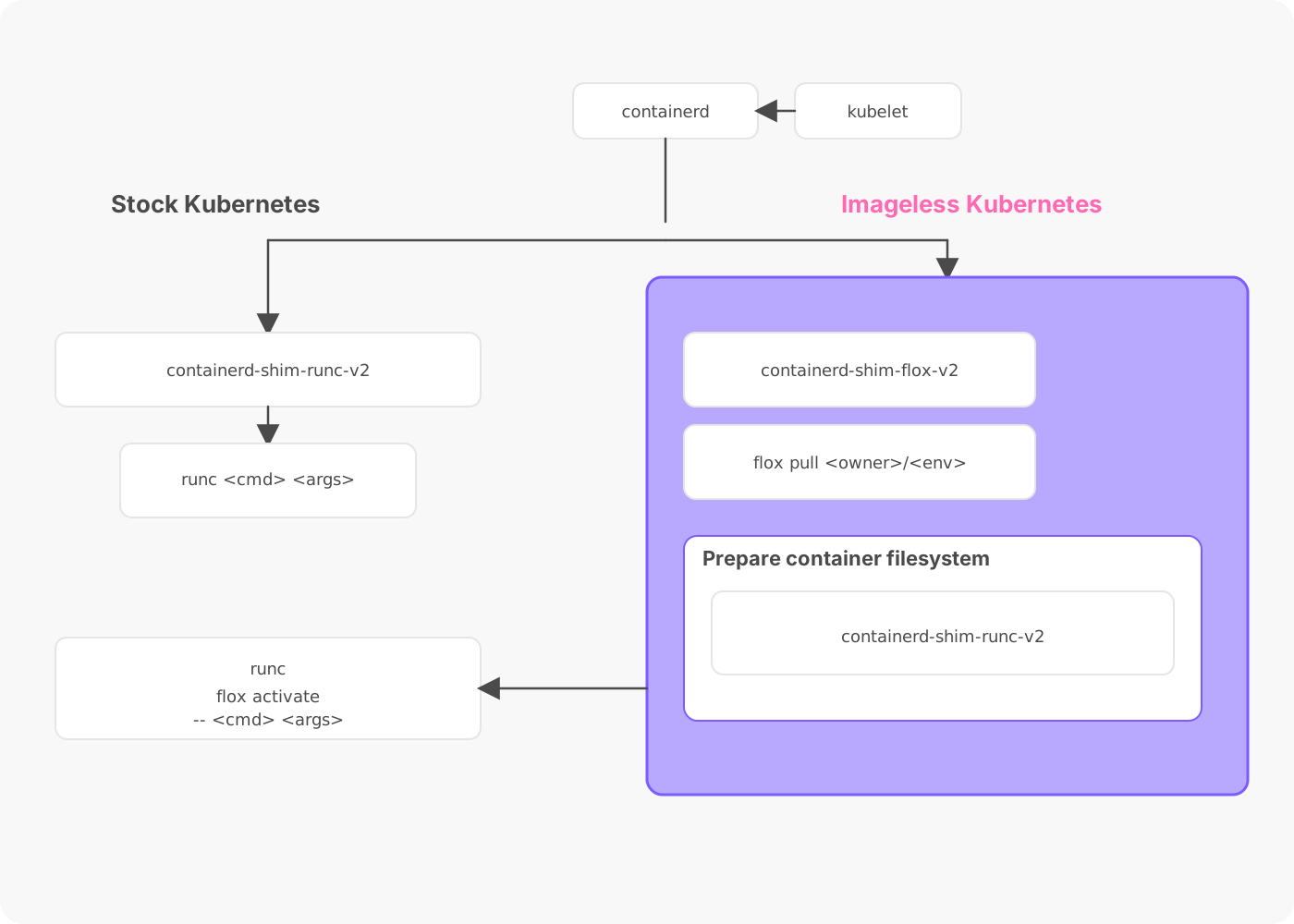
The upshot: the Flox shim doesn’t change how Kubernetes works—you continue to use the same primitives and the same API. You submit the same manifests (Helm/Kustomize, GitOps PRs), target the same objects (Pods, Deployments, Jobs, CRDs), and use the same mechanics (apply/patch, watch, RBAC). Observability logs to stdout/stderr, events, metrics, and traces flow as they do today. The only change involves selecting a different runtime handler (spec.runtimeClassName: flox) and adding a Pod template annotation (flox.dev/environment).
Your security, compliance, and process layers plug in exactly as they do now. Kubernetes admission control can gate on the Flox environment annotation in the Pod template and its SBOM—just as it gates on image digests today. OIDC/IAM, SSO, audit policies, quotas, and admission-time policy engines remain in force; registries plus file/image scanners keep working. Kubernetes stays Kubernetes—Flox changes how the pod is realized at start, not your operational investments—and definitely not the Kubernetes API.
Declarativity, Uncontained
About that API: It’s a canonical example of the declarative or “desired-state” model at work: You declare a desired state, expressing it in YAML or JSON, and the Kubernetes API server persists this as a validated, versioned object, encoding your intent in the object’s .spec field. Kubernetes controllers watch these objects, reconciling the observed state of the cluster toward the desired state as materialized in the .spec. But while Kubernetes deployments are declarative, the workloads they declare are not.
A Dockerfile is not, by itself, declarative. An image pinned by digest is not declarative. Creating Dockerfiles that build deterministic images—i.e., the same digest hash, at any time, on any machine—requires a combination of sustained discipline…and luck. In many orgs, this is so difficult as to be practically impossible.
Flox, powered by Nix, closes this gap, bringing the virtues of the declarative, desired-state model to Kubernetes workloads as well. Nix works by modeling a build or runtime environment as a purely functional derivation. A derivation is a declarative build recipe that lists all of the inputs (including not just sources, but environment variables, build flags, steps, etc.) that go into building and packaging software. A Nix package is a content-addressed dependency set: not just an application, tool, service, etc., but all of its transitive dependencies. These outputs live in an immutable store at paths like /nix/store/<hash>-<name>, where the <hash> is always derived from the environment’s declared inputs.
Kubernetes, Uncontained isn’t in any sense an unproven pattern. Anthropic uses something similar in its environment. Separately, companies like SysEleven, one of Germany’s most popular cloud services providers, trusts Nix to bring declarative determinism to its Kubernetes workloads—including, surprisingly, its CRDs. Though nominally declarative, these are difficult to package and version reproducibly. Nix gets it right every time.
Why Flox?
All of this invites a question: How or why is this a problem for Flox to solve?
Because running workloads reproducibly on Kubernertes is also a software packaging problem.
By themselves, OCI images do not guarantee the provenance, traceability, and (as it were) “identity” of the artifacts they contain. The one thing OCI images can guarantee is that these artifacts haven’t been tampered with after being pushed to a registry and pinned to a digest hash. But even though the Dockerfile or lockfiles you use to build your OCI images might specify the same versions of packages, are these packages in fact identical to the ones you validated at build time? That is, do they contain exactly the same bits? To get this assurance, you need an input- or content-addressed building and packaging step.
Package management is, then, the “last mile” in workload reproducibility—on Kubernetes or anywhere.
So why Flox? Because Flox is powered by Nix, the open source package/environment manager and universal build system. Deterministic building and packaging is one of Nix’s superpowers. Flox brings that superpower to everybody by surfacing intuitive ergonomics—Git-like CLI semantics; declarative environment definitions expressed as TOML—that abstract Nix’s complexity. And beyond what Nix itself provides, Flox adds a managed, curated catalog of software and a hosted hub that function as a shared system of record for environment versions (called “generations”), SBOMs, promotion/rollback, CVE remediation, and so on.
Benefits, Uncontained
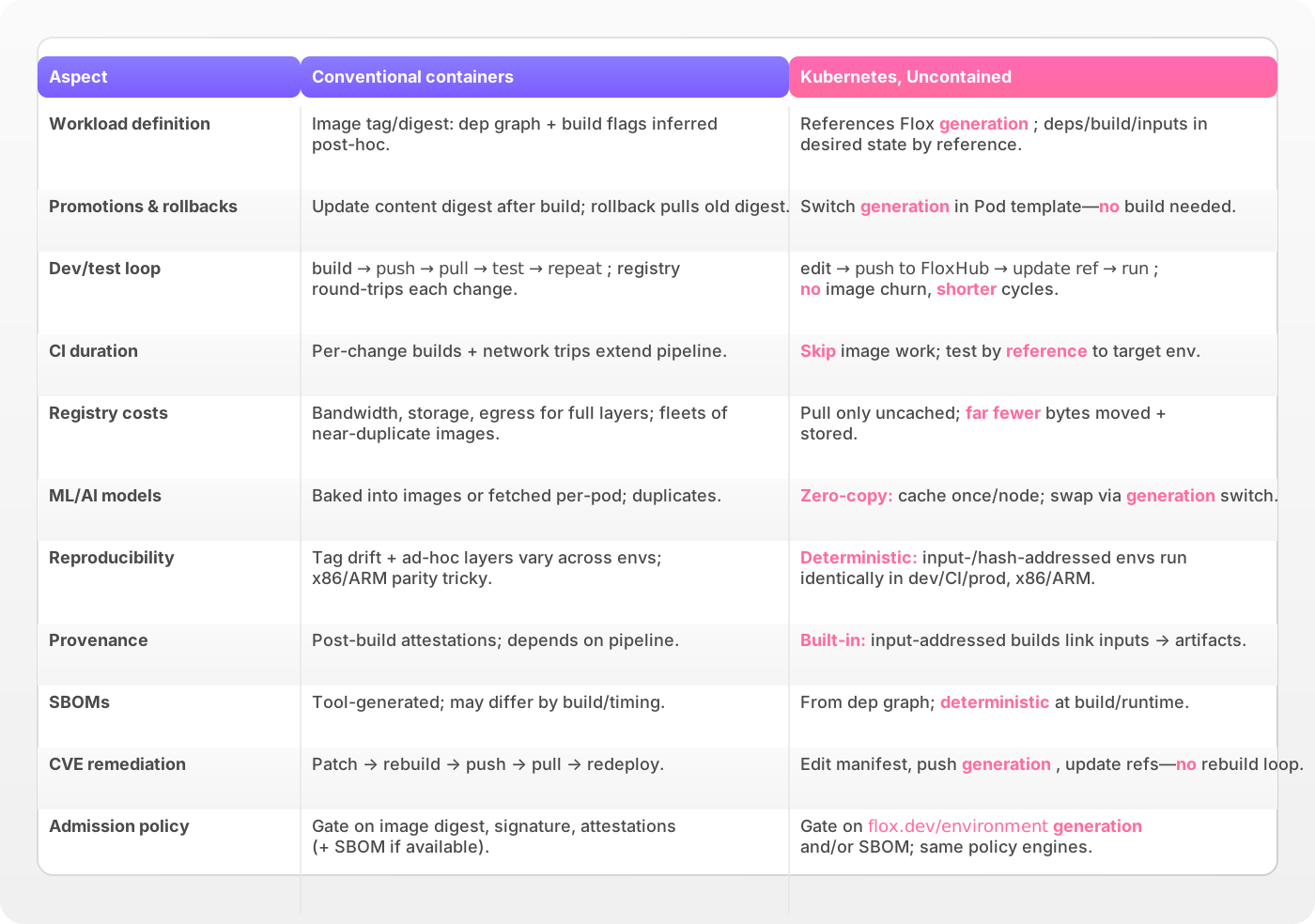
If Kubernetes lets you declare what should run, Kubernetes, Uncontained lets you declare what it is you’re running. With Kubernetes Uncontained, controllers still reconcile desired state, but now your workload’s dependency graph, build flags, and inputs are part of that desired state, too.
This gives you a declarative, reference-driven model from start to finish. From the moment a Deployment/Pod .spec gets applied, Kubernetes carries that declared intent forward—and, with Flox/Nix anchoring the last mile, binds the workload’s dependencies and build inputs to an immutable, hash-addressed reference.
Benefits include:
- Declarative workloads. Reference an immutable Flox generation in your Pod spec so the dependency graph, build flags, and inputs become part of desired state.
- One-line promotions and rollbacks. Promoting or rolling back is as simple as changing a single line in your Pod template to specify a different generation (version) of a Flox environment.
- An end to the container rebuild push-pull loop.
Replace build → push → pull → test → repeatwithedit env → push to FloxHub → update reference → run, shrinking cycle times. - Shortened CI runs. Skip per-change image builds and round-trips; test by reference.
- Reduced registry costs. Cuts down on bandwidth, storage, and egress by pulling only what isn’t cached; avoids maintaining fleets of near-duplicate images.
- Zero-copy model reuse for ML/AI workloads. Cache dependencies and models once per node; swap models by changing Flox environment generations in your Pod templates.
- Deterministic reproducibility across the SDLC. The same hash-addressed environment runs identically in local dev, CI, and prod K8s clusters—on x86 or ARM—eliminating “works on my machine” incidents.
- Provenance by construction. Input-addressed builds (from Nix/Nixpkgs) provide a tamper-evident chain from declared build inputs to runtime artifacts.
- SBOMs by default. Deterministic build-time and runtime SBOMs derived from the dependency graph itself.
- Rapid CVE remediation. Query SBOMs, edit manifests, push new generations, update Pod specs—no rebuild/push/pull loops.
- Policy-based runtime enforcement. Kubernetes admission controllers can gate on a Flox environment’s generation and/or the SBOM that is a derived product of that generation.
Ready to Go Uncontained?
Kubernetes, Uncontained paves the last mile in Kubernetes-driven and GitOps workflows.
That last mile is software packaging: the content- or input-addressed build step that binds what you intend to run—your declared state—to the workloads that actually run in your Kubernetes pods.
With Kubernetes, Uncontained, you make changes to a declarative Flox definition, push that to FloxHub, change a single line in your workload’s Kubernetes Pod spec, and run. That’s it. You test, ship, deploy, and/or roll back faster, easier, and more reliably—without building and testing images locally, then pushing them to a registry...only to pull, run, and test them again in CI. That vicious build-push-pull-repeat cycle just goes away.
Ready to go Uncontained? Get started here!